
Tahalka Today Team
Lucknow, August 25, 2026
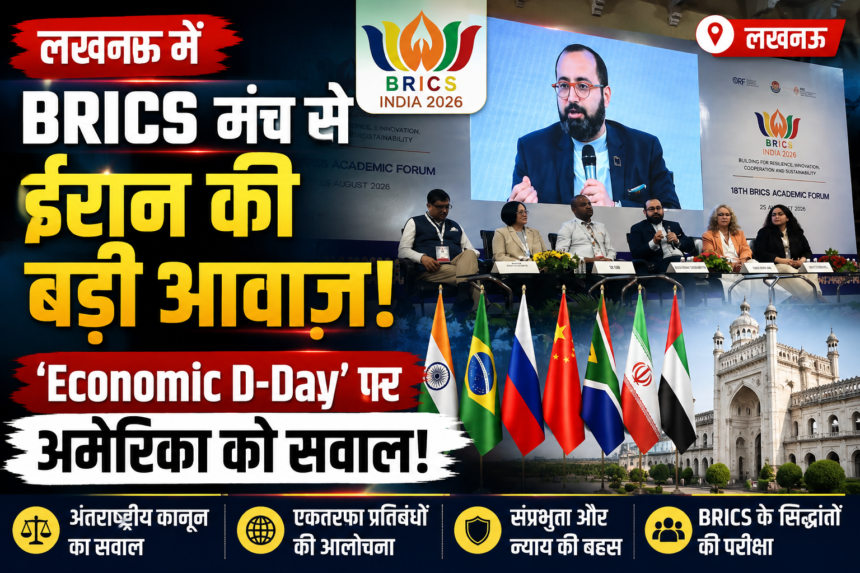
The 18th BRICS Academic Forum, being held in Lucknow, has brought Iran’s concerns over economic sanctions, national sovereignty and international law into the centre of a wider global debate.
Dr. Omid Babelian, representative of Iran’s Institute for Political and International Studies (IPIS) in India, raised questions over the so-called “Economic D-Day” and its potential implications for Iran’s sovereignty and the principles of international law.
According to a message shared by Iran in India, Dr. Babelian highlighted the economic pressure being imposed on Iran and linked the issue not merely to the Iran-US dispute, but to a broader test of sovereignty, international law and the emerging multipolar world order.
His remarks come at a time when Washington has intensified economic pressure on Iran and warned of measures that could also affect third countries and entities maintaining economic relations with Tehran.
Why Has Lucknow Become an Important Platform for This Debate?
The fact that this important discussion concerning Iran has emerged from the BRICS Academic Forum in Lucknow carries a significance of its own.
Lucknow is widely recognised as one of India’s important centres of Shia religious, cultural and intellectual heritage. Its historical relationship with Iran extends beyond contemporary diplomacy and includes long-standing links involving religious scholarship, culture, literature and social interaction.
The intellectual influence associated with Imam Khomeini, the Iranian Revolution and Iran’s broader political and religious thought has also found space in sections of Lucknow’s religious and intellectual discourse over the decades.
It is against this backdrop that an Iranian representative raising questions about international order, sovereignty and economic sanctions in Lucknow assumes an added local and cultural significance.
There have been various social and political claims regarding the size of the Shia population in Uttar Pradesh and Lucknow. However, there is no recent official census figure establishing the specific numbers claimed by different sources. What can be stated with confidence is that Uttar Pradesh, and particularly Lucknow, has a significant and historically rooted Shia social and cultural presence.
What Exactly Is the “Economic D-Day”?
US Treasury Secretary Scott Bessent has described the intensified American economic campaign against Iran as an “Economic D-Day.”
The latest reports indicate that the Trump administration has been increasing economic pressure on entities and countries maintaining commercial links with Iran, including the possibility of secondary sanctions.
The measures reportedly target a broad range of Iran-linked individuals, entities and vessels, with sectors including digital assets, technology, gold, aviation and shipping coming under scrutiny.
The central message from Washington is that companies and countries continuing significant economic engagement with Iran could face serious consequences within the US-led financial system.
This is where the issue moves beyond the bilateral Iran-US confrontation and becomes a question of global trade, financial sovereignty and the freedom of states to conduct independent economic relations.
Dr. Babelian Reminds BRICS of Its Own Declaration
One of the most significant aspects of Dr. Babelian’s remarks was his reference to the 2025 BRICS Rio de Janeiro Declaration.
BRICS leaders, in that declaration, criticised unilateral coercive measures that are contrary to international law. The declaration also expressed concern over the impact of unilateral economic sanctions and secondary sanctions.
BRICS called for the elimination of such measures, noting their potential impact on ordinary people, including consequences for development, health, food security and human rights.
This makes the question raised from Lucknow directly relevant to the principles that BRICS itself has already articulated.
The Bigger Question: What Will BRICS Do When Its Principles Are Tested?
This is perhaps the most important question emerging from the debate.
If BRICS seeks to promote a more balanced and multipolar international order, will its declared principles remain applicable when a BRICS member or its strategic partner comes under intense economic pressure?
The essence of Dr. Babelian’s message can be summed up in one principle:
The real value of principles is not tested when they are easy to uphold; it is tested when upholding them becomes difficult.
The question therefore extends beyond Iran.
It concerns the credibility of BRICS itself as an emerging platform representing a broader group of countries seeking greater balance in global governance.
Pressure on Iran, But All Eyes Are Also on China
China is an important factor in the new US strategy toward Iran.
China remains a major economic partner of Iran and a significant buyer of Iranian oil. Any attempt to severely restrict Iran’s economic networks therefore inevitably raises the question of how far Washington is prepared to go in confronting countries such as China that maintain substantial economic relations with Tehran.
This is why the term “Economic D-Day” is no longer simply a story about sanctions against Iran.
It increasingly connects US-Iran relations, US-China tensions, global energy markets, international trade and the future role of BRICS.
Iran’s Response: Tehran Says It Will Not Be Forced Into Submission
Iranian officials have publicly adopted a firm position in response to the latest American economic pressure.
Iran has repeatedly argued that it has lived under sanctions for decades and has developed economic and bilateral mechanisms to withstand external pressure.
At the same time, independent analysts warn that prolonged sanctions, economic difficulties and geopolitical tensions could create serious challenges for the Iranian economy.
The coming weeks will therefore be crucial in determining how effectively Washington’s new measures affect Iran and how successfully Tehran can use its relationships with major trading partners to maintain economic space.
Why Is Iran’s Voice Important Within BRICS?
For Iran, BRICS is much more than an economic cooperation platform.
Tehran sees the grouping as part of the broader movement towards an international system in which global decision-making is not dominated by a small number of Western powers.
That is why Iran’s emphasis on sovereignty, unilateral sanctions and international law at an academic platform such as the BRICS Academic Forum carries both political and strategic significance.
The 18th BRICS Academic Forum, held in Lucknow from 23 to 25 August 2026, has brought together academics, researchers and policy thinkers from BRICS countries to discuss the future of cooperation and global governance.
How Far Does the Debate from Lucknow Go?
The debate emerging from the Lucknow forum goes far beyond Iran.
It raises four fundamental questions:
First: Can one country use its financial power to influence the economic decisions of other sovereign states?
Second: Is it legitimate to penalise third countries for maintaining lawful economic and trade relations with another country?
Third: Can BRICS translate its stated principles of multipolarity and sovereign equality into practical policy?
Fourth: Can the Global South develop alternative economic and financial mechanisms to withstand unilateral economic pressure?
These questions are likely to remain central to the future debate surrounding BRICS.
Lucknow’s Message: It Is Time to Move Beyond Declarations
The significance of Dr. Omid Babelian’s intervention in Lucknow lies in the fact that it goes beyond simply presenting Iran’s position.
At its core, the debate concerns an international system in which the principles of international law, national sovereignty, independent foreign policy and economic freedom are facing a real-world test.
BRICS expressed concern over unilateral and secondary sanctions in its 2025 declaration. Now, as Iran faces another phase of intensified economic pressure in 2026, attention is turning towards whether BRICS will keep those principles confined to diplomatic documents or seek to translate them into meaningful collective positions.
And this is perhaps why the voice raised by Dr. Omid Babelian from Lucknow has become more than simply Iran’s voice.
It has become part of the larger global debate over multipolarity, sovereign equality, economic independence and the future architecture of international relations.
Special Report by Syed Rizwan Mustafa
Lucknow | August 25, 2026