


By: Taqi Hasnain
Lucknow | November 28, 2026
A city may be remembered for its magnificent buildings, wide roads and bustling marketplaces, but the true identity of a society is reflected in its educational institutions and the people who dedicate themselves to shaping the future of generations.
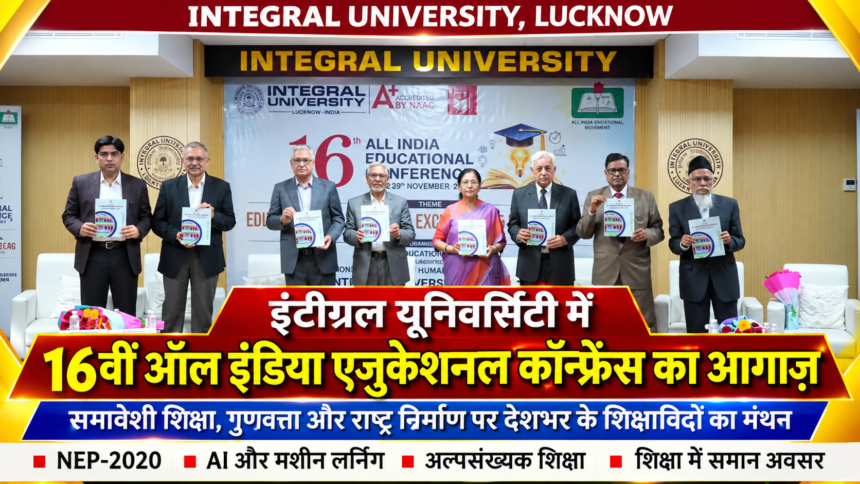
Some people build structures that stand for years, while others build ideas, opportunities and institutions that continue to inspire generations. This spirit was reflected at Integral University, Lucknow, on Saturday, as the 16th All India Educational Conference commenced with an inspiring gathering of eminent academicians, educationists, former vice-chancellors and intellectuals from across the country.
At the heart of this important academic initiative was the vision of Prof. Syed Waseem Akhtar, Founder and Chancellor of Integral University, whose approach to education goes beyond classrooms, degrees and academic achievements. His emphasis on institutional responsibility, social commitment and the empowerment of society through education gave the inaugural occasion a distinctive significance.
The two-day conference is being organised under the aegis of the All India Educational Movement (AIEM), in collaboration with the Faculty of Education and the Faculty of Humanities, Social and Behavioural Sciences of Integral University.
The central theme of the conference is “Education for Inclusion, Quality and Nation Building.”
Prof. Waseem Akhtar: A Chancellor’s Vision Beyond University Walls
Presiding over the inaugural session, Prof. Syed Waseem Akhtar spoke about the social responsibilities of universities and the initiatives undertaken by Integral University to contribute to society.
Through inspiring examples and reflections, he highlighted the broader purpose of education and the responsibility of academic institutions towards communities and future generations.
His message reflected an important principle: the success of a university should not be measured merely by its infrastructure, academic programmes or the number of degrees it awards. Its real contribution lies in the opportunities it creates, the lives it transforms and the positive impact it makes on society.
Prof. Akhtar also expressed his gratitude to the All India Educational Movement for organising the national conference at Integral University.
The inaugural session concluded with the formal release of the AIEM Souvenir by the distinguished guests.
National Education Leaders Gather to Discuss India’s Academic Future
The conference began with a welcome address by Prof. Mohammad Haris Siddiqui, Registrar of Integral University.
In his introductory address, Dr. Khwaja M. Shahid, former Vice-Chancellor of Maulana Azad National Urdu University (MANUU), Hyderabad, and President of AIEM, recalled the previous conference and emphasised the importance of extending educational opportunities to disadvantaged and underprivileged sections of society.
He stressed that education must become an effective instrument of social transformation, ensuring that no section of society remains deprived of opportunities for progress.
“Education Without Discrimination Is Essential for Nation Building”: Prof. Furqan Qamar
Delivering the keynote address, Prof. Furqan Qamar, Vice-Chancellor of Integral University, advocated an education system that provides equal opportunities to all, irrespective of social or economic background.
He highlighted the fundamental role of modern education in nation building and stressed the need to ensure that every individual gets an opportunity to develop their abilities and contribute to the country’s progress.
His address reinforced the idea that educational excellence must go hand in hand with accessibility, equality and inclusion.
NEP 2020, Artificial Intelligence and Machine Learning: Shaping the Future of Education
Special Guest Dr. Sushil Solomon, former Vice-Chancellor of Chandra Shekhar Azad University of Agriculture and Technology, Kanpur, discussed the transformative potential of the National Education Policy 2020.
He also highlighted the growing importance of Artificial Intelligence (AI) and Machine Learning (ML) in education, research and national development.
He underlined the need for India’s educational institutions to adapt to technological advancements and equip students with the knowledge and skills required to meet emerging global challenges.
Educational Policies Must Deliver Results on the Ground: Prof. Mohammad Miyan
Prof. Mohammad Miyan, former Vice-Chancellor of Maulana Azad National Urdu University, emphasised the importance of regularly reviewing educational policies and ensuring their effective implementation.
He observed that framing policies alone is not sufficient; their actual impact must be assessed to ensure that intended benefits reach students and educational institutions.
His remarks highlighted the importance of accountability, implementation and measurable outcomes in educational development.
Government Support for Minority Education Is Essential: Dr. Fauzia Khan
Dr. Fauzia Khan, former Rajya Sabha Member of Parliament and Patron of AIEM, who co-chaired the conference, drew attention to the educational needs of minority communities.
She stressed that greater governmental attention and support for minority education are essential to achieving inclusive development.
Describing teachers as the backbone of the education system, she highlighted their vital role in nurturing responsible citizens and shaping the future of the nation.
Technical Sessions Focus on Emerging Educational Challenges
Following the inaugural ceremony, the conference moved into its specialised technical sessions.
The discussions are focusing on educational quality, social inclusion, the National Education Policy, technological innovation, research and the role of educational institutions in nation building.
The two-day academic gathering is expected to provide an important platform for exchanging ideas, sharing experiences and exploring practical approaches to strengthening India’s education system.
Beyond Infrastructure: Building a Legacy of Knowledge and Social Responsibility
The proceedings at Integral University brought into focus a larger question: What should be the true measure of an educational institution’s success?
Is it merely the scale of its infrastructure, the number of courses it offers or the degrees it awards? Or is it the number of lives it transforms and the opportunities it creates for those who need them most?
Under the leadership of Chancellor Prof. Syed Waseem Akhtar, the conference provided an opportunity to reflect on the broader social purpose of higher education and the responsibility of universities towards society.
Ultimately, a university’s greatest legacy is not simply the buildings it constructs, but the generations it educates, the minds it inspires and the positive changes it brings to society.
When education moves beyond textbooks and begins transforming lives, when universities recognise their responsibility beyond campus boundaries, and when institutional leadership places the future of generations at the centre of its vision, education becomes more than an academic pursuit—it becomes a mission of social transformation and nation building.
That, perhaps, is the most meaningful legacy an educational institution can aspire to create.