

Lucknow, November 17, 2026 | Report: Syed Rizwan Mustafa
There was a time when filariasis silently affected thousands of lives across Uttar Pradesh. For many families, the disease meant years of physical suffering, swelling, disability and social challenges. What once appeared to be a widespread public health concern is now showing signs of significant improvement.
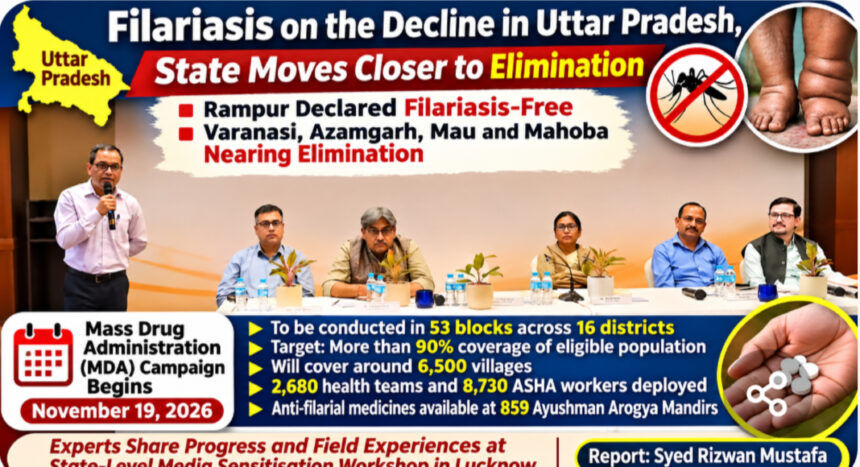
Uttar Pradesh is steadily moving towards its goal of eliminating filariasis. From 782 affected blocks across 51 districts, the state has brought the geographical spread of infection down considerably. Rampur has already been declared filariasis-free, while Varanasi, Azamgarh, Mau and Mahoba are approaching the same milestone.
The latest figures reflect a major change in the state’s fight against the disease. According to health officials, only 53 blocks across 16 districts now require the upcoming Mass Drug Administration (MDA) campaign.
November 19: A Crucial Day in the Fight Against Filariasis
The next phase of the campaign will begin on November 19, with health authorities aiming to ensure that more than 90 per cent of the eligible population consumes the prescribed anti-filarial medicines.
Experts believe that achieving this target will further reduce transmission and strengthen the state’s progress towards elimination.
State Filaria Officer Dr. A.K. Chaudhary shared these details during a state-level media sensitisation workshop held at a local hotel in Lucknow on Tuesday. The workshop was organised in collaboration with the Centre for Advocacy and Research (CFAR).
Dr. Chaudhary explained that 412 blocks have now become non-endemic, while infection levels have declined considerably in another 149 blocks, according to Night Blood Surveys.
Thousands of Health Workers to Reach Villages and Households
The upcoming campaign has been planned on a large scale to ensure that no eligible person is left behind.
The programme will cover approximately 6,500 villages, with 2,680 health teams and 8,730 ASHA workers deployed for implementation. Anti-filarial medicines will also be available at 859 Ayushman Arogya Mandirs.
Health teams will visit households and administer medicines in the presence of beneficiaries to encourage proper consumption.
Several departments, including Basic and Secondary Education, Panchayati Raj, Uttar Pradesh State Rural Livelihoods Mission (UPSRLM) and the National Service Scheme (NSS), are also extending their support.
16 Districts to Participate in the Campaign
The MDA campaign will cover selected blocks in Kanpur Nagar, Unnao, Kanpur Dehat, Chitrakoot, Sitapur, Shahjahanpur, Lakhimpur Kheri, Shravasti, Prayagraj, Gonda, Hardoi, Kannauj, Ballia, Farrukhabad, Fatehpur and Kaushambi.
Fatehpur will have the highest coverage, with 11 blocks included in the campaign, followed by Sitapur with 10 blocks and Kanpur Dehat with seven.
Special Focus on Migrants and People Who Have Never Taken the Medicine
One of the major priorities this time is reaching people who have previously missed the opportunity to take anti-filarial medicines or refused them.
According to the Health Department, a database has been prepared identifying:
- 191,487 people who have never taken anti-filarial medicines.
- 538,351 migrant residents.
- 331,368 people who previously refused to take the medicines.
Health workers will make special efforts to counsel these groups and encourage them to participate in the campaign.
Filariasis Elimination Requires Collective Responsibility
Director Dr. Rekha Rani emphasised that eliminating filariasis cannot be the responsibility of the Health Department alone.
She called for active participation from local bodies, educational institutions, Panchayati Raj organisations, community groups and other government departments.
According to her, coordinated efforts and public participation are essential to achieve sustainable results.
Patients Share Their Experiences and Community Efforts
The workshop also provided an opportunity for members of the Patient Stakeholder Platform (PSP) to share their experiences.
Gram Pradhan Rambabu from Unnao, Rarita Devi from Sitapur and Basant Lal Gupta from Kanpur spoke about their experiences and the importance of community support in spreading awareness and encouraging people to take preventive medicines.
Among those present were Dr. Ataur Rahman, Deputy General Manager of the National Health Mission; Dr. Pankaj Saxena, Joint Director (VBD); Dr. Manik Relan, Programme Officer at the Gates Foundation; and Ranpal Singh from PCI.
Representatives from WHO, PCI, PATH, GHS and CFAR also attended the workshop.
The Final Challenge: Reaching Every Eligible Person
The declining spread of filariasis in Uttar Pradesh is an encouraging development, but the journey towards complete elimination is not over yet.
The November 19 campaign will be an important test of public participation and the effectiveness of the state’s healthcare network.
Health officials have appealed to citizens to cooperate with healthcare workers and take the prescribed anti-filarial medicines according to official guidelines.
The fight against filariasis is no longer just a government health programme; it is a collective mission. Its ultimate success will depend on awareness, public participation and ensuring that no eligible person is left behind.